

 English
 Deutsch
Making a suitcase lighter sounds straightforward: use less plastic and reduce the shell thickness. The difficulty becomes obvious when the luggage is dropped, squeezed between other bags or handled roughly during airport transfers. A shell that is too thin may crack, while excessive reinforcement adds weight and reduces the benefit of a lightweight design.
For luggage manufacturers, the challenge is to remove unnecessary material without weakening areas that take the most impact. Developing Light Weight Hard Shell Luggage involves choosing the right plastic, designing the shell shape and paying particular attention to corners, wheel mounts and handle connections.
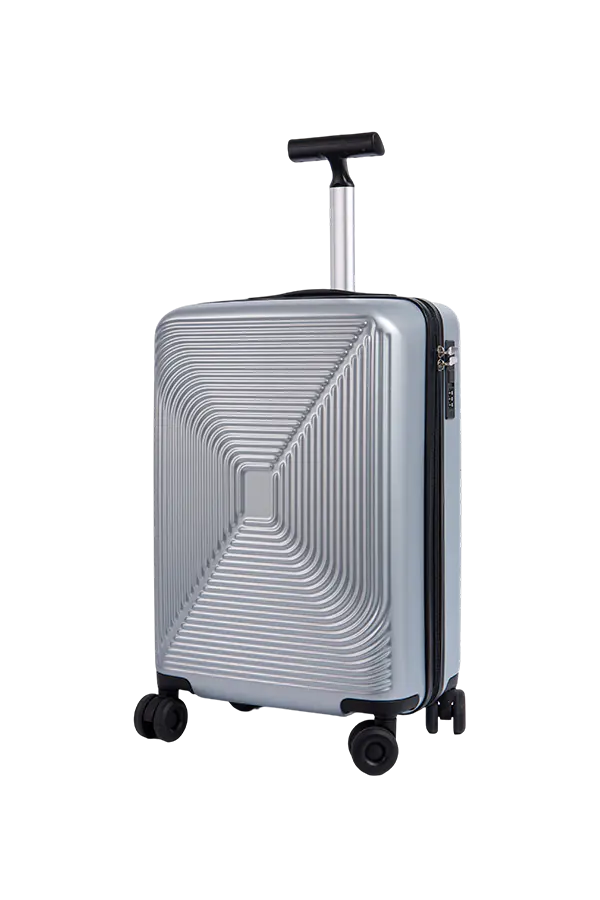
Choose Plastic Based on Strength and Weight
The material has a major influence on how a suitcase behaves when it is dropped or pressed against other luggage. Different plastics offer different combinations of flexibility, rigidity, impact resistance and production cost.
Three commonly used materials are:
- Polypropylene (PP): Lightweight and relatively flexible. It can deform under impact and recover its shape, depending on the material grade and shell construction.
- Polycarbonate (PC): Offers good impact resistance and flexibility, making it suitable for luggage that needs to withstand frequent handling. Its material cost is generally higher.
- ABS: Provides good rigidity and is widely used in cost-conscious luggage production. Its impact resistance depends on the formulation and can be more limited under certain conditions.
PC-ABS blends are another option when manufacturers want to balance rigidity, impact performance and cost.
There is no material that suits every suitcase. A budget carry-on and a large checked suitcase may have different weight targets, shell requirements and price constraints. Resin selection should reflect how the finished product will actually be used.
Reduce Shell Thickness Carefully
Shell thickness has a direct effect on suitcase weight, but reducing it too much can leave certain areas vulnerable to impact.
Corners, edges, wheel housings and handle mounting points generally experience more concentrated forces than broad sections of the shell. These areas may need additional support even when the remaining shell is relatively thin.
Manufacturers can use different thickness distributions rather than making the entire shell equally thick. Molded reinforcement and carefully positioned ribs can also improve stiffness without adding material everywhere.
CAD modeling and finite element analysis help engineers locate potential stress concentrations before tooling begins. However, simulation results still need to be checked against physical samples. Actual molding conditions and material behavior can produce differences that are difficult to predict from a computer model alone.
Let the Shell Shape Provide Some of the Strength
The geometry of a suitcase contributes to its ability to resist impact and deformation. A large flat panel behaves differently from a curved surface or one with molded ribs.
Several design details can help:
- Rounded corners reduce sharp transitions where stress may concentrate.
- Curved shell surfaces can improve stiffness in selected areas.
- Molded ribs provide additional support without requiring a uniformly thick wall.
- Reinforced edges help protect vulnerable perimeter sections.
- Well-designed wheel housings distribute forces around mounting points.
More reinforcement is not always better. Too many ribs or excessively thick sections add weight and may create uneven material distribution during molding. Manufacturers need to find a structure that provides support where it is needed without making the entire suitcase heavier.
Match the Manufacturing Process to the Shell Design
Injection molding and thermoforming are both used in hard-shell luggage production, but they have different characteristics.
Injection molding is suitable for producing detailed shapes and integrated structural features with controlled dimensions. Thermoforming uses heated plastic sheets shaped over a mold. It can produce lightweight shells, although material stretching may cause thickness variations around complex corners and curved sections.
Production control is important with either method.
| Design factor | Manufacturing consideration | Quality objective |
|---|---|---|
| Material formulation | Resin grade and additives | Consistent impact performance |
| Shell thickness | Wall distribution and tolerance | Avoid weak sections |
| Mold design | Corners, ribs and transitions | Maintain structural strength |
| Processing temperature | Material-specific settings | Reduce molding defects |
| Cooling conditions | Cooling rate and shrinkage | Control warping |
| Finished shell | Surface and structural inspection | Maintain product consistency |
Changes in molding temperature, pressure or cooling conditions can affect the finished shell. Manufacturers should inspect samples from different production batches rather than assuming that an approved prototype guarantees identical results in mass production.
Reinforce the Parts That Take the Most Stress
The shell is only one part of a suitcase. Wheels, telescopic handles, carry handles and locking systems are also exposed to repeated forces during travel.
Wheel mounts deserve particular attention because they transfer loads directly into the lower shell. If the mounting area is too weak, cracks may develop after repeated impacts or rough handling.
Reinforcement can include stronger mounting sections, suitable metal brackets, engineering-plastic supports and better load distribution around fasteners.
The same principle applies to handle connections. A handle may be strong enough on its own, but its mounting points can still fail if the surrounding shell is too thin.
Adding metal reinforcement everywhere would defeat the purpose of lightweight construction. Each component should be strengthened according to the forces it is expected to handle.
Put the Finished Suitcase Through Physical Tests
Material specifications provide a starting point, but they cannot tell the whole story. A finished suitcase needs to be tested with its wheels, handles, locks and internal structure assembled.
| Test method | What it evaluates | Possible design adjustment |
|---|---|---|
| Corner impact | Damage around vulnerable corners | Modify corner geometry |
| Drop test | Overall shell and assembly strength | Adjust thickness and reinforcement |
| Compression test | Resistance to external pressure | Improve shell stiffness |
| Wheel cycling | Wheel and mounting durability | Reinforce brackets and connections |
| Handle fatigue test | Handle and attachment strength | Improve mounting structure |
| Temperature conditioning | Changes in material behavior | Review resin grade and shell design |
Test conditions should reflect the product's intended use. A result from one suitcase size or resin formulation should not automatically be applied to every model in the product range.
Don't Forget Weight Distribution and Usability
A lightweight suitcase can still feel awkward if its weight is poorly distributed. Heavy components concentrated at one end may make it harder to maneuver, while incorrectly positioned wheels can increase rolling resistance.
Manufacturers should consider the relationship between shell dimensions, wheel placement, handle position and internal storage layout.
Available packing space matters too. Reinforcement structures, lining and hardware take up room inside the suitcase. Reducing the external weight is useful, but not at the expense of the usable storage capacity that customers expect.
Getting the Balance Right
Developing Light Weight Hard Shell Luggage is not simply a matter of making the plastic shell thinner. The resin, shell geometry, reinforcement and molding process all affect how the finished suitcase responds to impact.
Manufacturers need to pay particular attention to corners, wheel mounts and handle connections, where failures are more likely to become noticeable. Testing complete suitcases under realistic handling conditions then shows whether material has been removed wisely or whether the design has become too weak.