

 English
 Deutsch
Choosing a hard-shell suitcase means juggling weight, price, appearance—the usual. But travel throws something else at luggage: temperature swings. A case might sit in a freezing aircraft hold, bake in a hot airport, or roast in a parked car under direct sun. Those conditions change how the plastic flexes, absorbs impact, and handles stress. Polycarbonate (PC) and polypropylene (PP) are two common hard-shell materials. Both can take a hit, but they behave differently as temperatures shift. Knowing those differences helps travelers and buyers pick a suitcase that fits their routes, handling conditions, and expected service life.
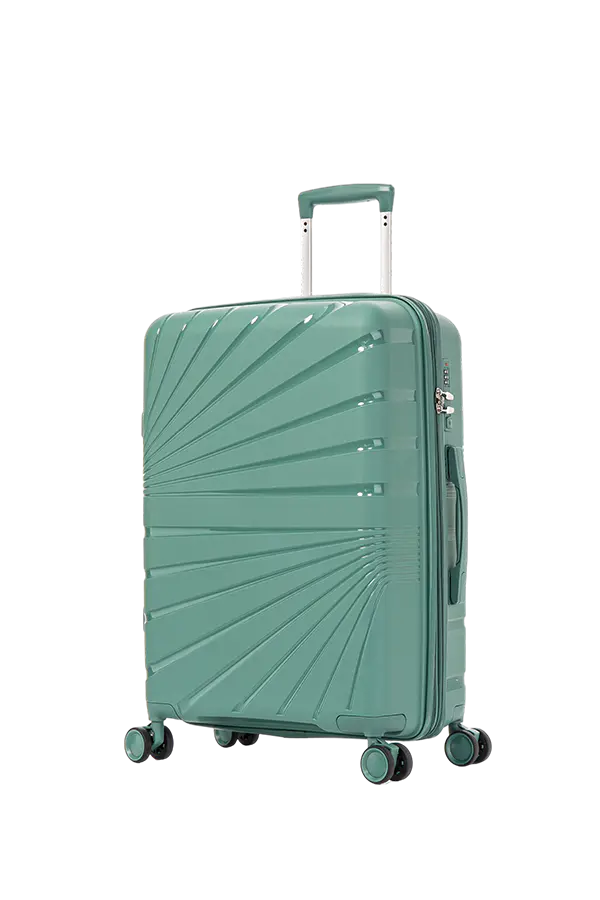
How Temperature Changes Thermoplastic Performance
PC and PP are thermoplastics—their mechanical properties change with temperature. Generally, plastics stiffen as temperatures drop and soften as they rise. How much depends on polymer grade, additives, wall thickness, molding quality, suitcase design.
Cold reduces a shell's ability to deform and absorb impact. A drop or sharp blow creates more stress around corners, ribs, handles, wheel attachments. Heat makes some plastics more flexible. A loaded suitcase may be more susceptible to temporary deformation if compressed or stored under heavy weight. These are general tendencies, not a guarantee every suitcase behaves the same way. Shell geometry, reinforcement, manufacturing quality all influence real-world performance.
Polycarbonate Suitcase Shells in Hot and Cold Conditions
Polycarbonate is known for impact resistance and toughness. It flexes under load and recovers shape when stress stays within material limits. That flexibility helps a suitcase handle knocks during baggage handling.
At low temperatures, PC generally retains useful impact performance compared with many more brittle plastics. But toughness still depends on grade and formulation. Severe cold, sharp impacts, pre-existing scratches, stress concentrations—they increase cracking risk. At elevated temperatures, PC becomes more flexible and stiffness declines. A suitcase left in a hot car or intense sunlight may soften somewhat. Prolonged heat combined with pressure or uneven loading is the bigger concern, particularly for thin or poorly supported shell sections.
PC suits frequent travelers who prioritize impact resistance. Buyers should also inspect shell thickness, corner construction, and the quality of the frame, zipper, wheels, handle mounts.
Polypropylene Suitcase Shells in Hot and Cold Conditions
Polypropylene is valued for low weight and flexibility. Many PP shells bend noticeably under pressure, helping them absorb certain impacts without permanently cracking. Its relatively low density makes it attractive for lightweight suitcase designs.
Temperature has a meaningful effect on PP's behavior. In cold conditions, PP becomes less ductile, and some grades are more vulnerable to brittle impact failure. The degree of change varies with polymer formulation and impact-modifying additives. A low-cost PP shell shouldn't automatically be expected to perform like a higher-grade product in freezing conditions.
In warm environments, PP generally becomes more flexible. That helps it tolerate deformation, but excessive heat and sustained loads may contribute to shape changes. Risk depends on temperature, exposure duration, shell design, how heavily the suitcase is packed.
PP suits travelers who prioritize low weight and flexibility. For trips involving very cold destinations or frequent rough handling, look for product-specific impact test information and clear material specifications.
Key Differences Between Polycarbonate and Polypropylene
| Selection factor | Polycarbonate (PC) | Polypropylene (PP) |
|---|---|---|
| Weight | Lightweight, but often heavier than comparable PP designs | Typically very lightweight |
| Flexibility | Tough with controlled flex | Often highly flexible |
| Cold-weather behavior | Generally maintains good impact toughness, depending on grade | Some grades become more brittle in cold conditions |
| Hot-weather behavior | Stiffness can decrease as temperature rises | Can become more flexible under heat |
| Impact performance | Often selected for high impact resistance | Can absorb impacts through shell flex |
| Typical buyer priority | Durability and impact resistance | Low weight and flexibility |
Neither material is universally superior. A well-designed PP suitcase may outperform a poorly molded PC case, while a quality PC shell may offer a better balance for demanding travel.
What Other Factors Affect Shell Performance?
Material choice is only one part of durability. Wall thickness and shell geometry determine how forces spread across the case. Molded ribs, rounded corners, reinforced attachment points reduce localized stress. Uneven thickness and sharp transitions create weak areas.
Manufacturing quality matters too. Inconsistent cooling, residual molding stress, unsuitable material blends affect impact behavior. Recycled content isn't automatically a problem, but its percentage, quality control, compatibility with the intended application should be verified.
Consider the complete suitcase. Wheels, telescopic handles, zippers, seams, internal frames—they may fail before the shell does. A strong shell offers limited benefit if wheel housings or handle mounts are poorly designed.
How to Choose a Suitcase for Your Travel Climate
For frequent travel to cold regions, prioritize documented low-temperature impact performance, robust corners, and a design with minimal stress concentrations. Ask manufacturers whether the shell has been tested at temperatures relevant to your travel conditions.
For hot climates, avoid leaving luggage in direct sunlight or a hot vehicle for extended periods. Don't place heavy objects on a warm suitcase, and follow the manufacturer's storage recommendations. These precautions apply to both PC and PP shells.
When comparing products, look for information about resin grade, shell construction, impact testing, warranty coverage. Marketing terms like "unbreakable" or "all-weather" aren't substitutes for test data. If a manufacturer provides a test standard and temperature range, check whether the method reflects the impacts and conditions the suitcase may encounter.
Make the Material Choice Fit the Journey
PC and PP can both deliver dependable hard-shell luggage when the resin, molding process, and overall design are appropriate. Polycarbonate is often attractive for toughness and impact resistance. Polypropylene stands out for low weight and flexibility. Cold temperatures can make some PP grades more vulnerable to brittle impact, while heat can reduce stiffness in both materials.
The practical choice comes from matching verified product performance to the climate, handling intensity, and loading conditions of the trip. Reviewing construction details and test information provides a more reliable basis for selection than material name alone. A material that works for one traveler's habits may not suit another's—that's just how it goes.