

 English
 Deutsch
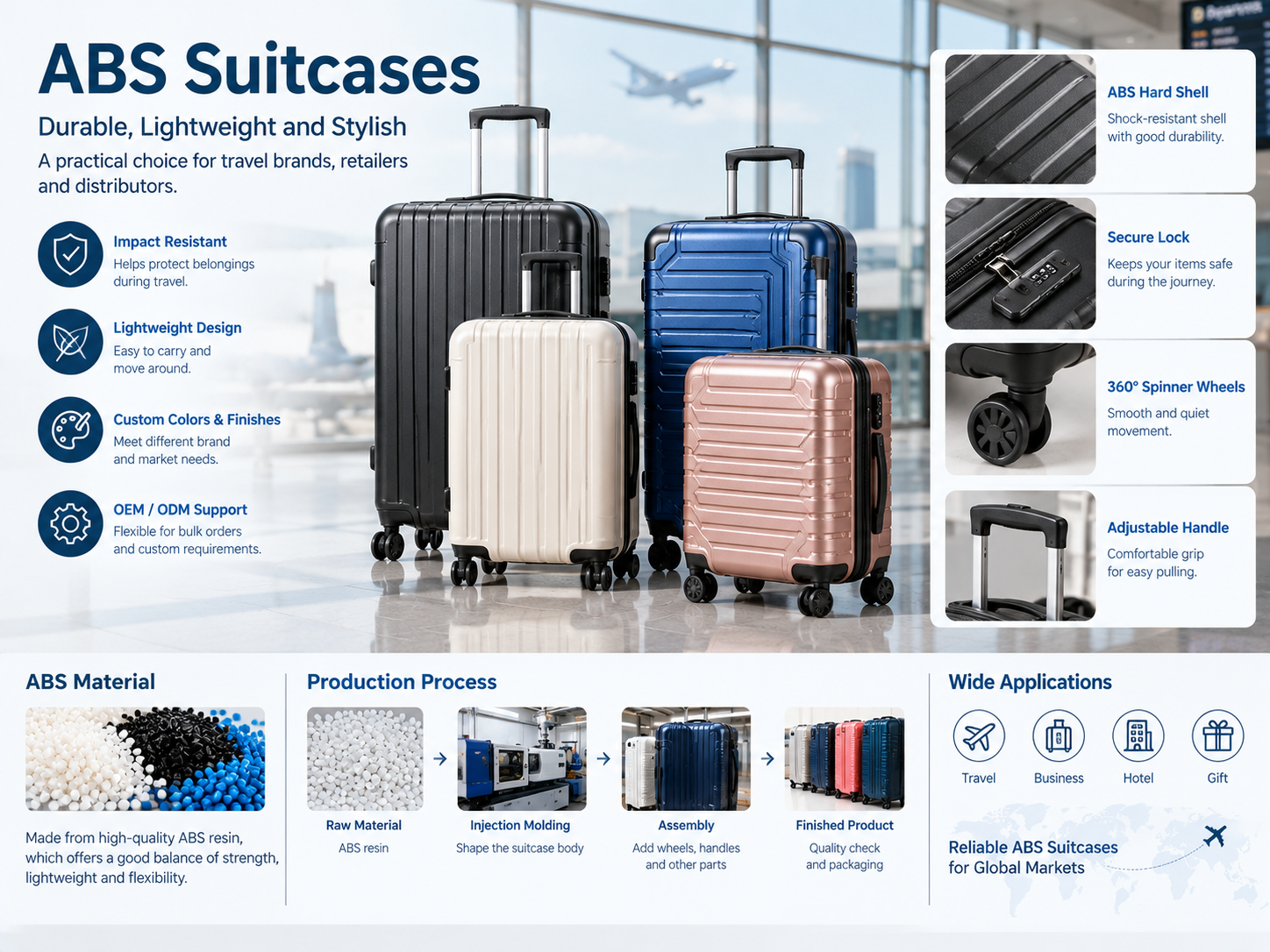
The luggage market keeps changing as travelers look for products that are reasonably light, durable, practical, and still affordable. In the hard-shell luggage segment, ABS Suitcases are getting attention from luggage brands, wholesalers, retailers, and consumers because ABS offers a useful mix of rigidity, impact resistance, design flexibility, and relatively manageable production costs.
ABS stands for acrylonitrile butadiene styrene. It is a thermoplastic widely used in consumer products and can be formed into rigid suitcase shells with different shapes, colors, textures, and surface details.
For B2B buyers, though, choosing ABS luggage is not simply a matter of checking the shell material. Shell thickness, construction, wheels, handles, zippers, interior fittings, testing, and production consistency all have a say in the finished product.
This article looks at why ABS suitcases are attracting attention and what luggage manufacturers, importers, distributors, and private-label brands should check before placing an order.
What Makes ABS Suitable for Suitcase Manufacturing?
ABS is known for its combination of rigidity, toughness, and relatively easy processing. That makes it useful when a product needs a molded outer shell.
In luggage production, ABS can be formed into different shell shapes through thermoforming and related processes. Manufacturers can work from a common material platform while developing different sizes and designs.
Some useful characteristics include:
- Rigid shell construction
- Relatively good impact resistance
- Easy shaping into different designs
- Broad color possibilities
- Smooth or textured surface options
- Suitable production efficiency for many luggage ranges
Of course, not every ABS suitcase performs the same way. Material grade, shell thickness, forming method, reinforcement, and assembly all matter. The word "ABS" alone does not tell a buyer how durable the finished suitcase will be.
Why Buyers Are Interested in ABS Suitcases
For luggage businesses, one attraction of ABS is the balance between product features and manufacturing flexibility.
Hard-shell luggage gives travelers a structured exterior, and ABS provides manufacturers with a practical way to create that shell for many mainstream product ranges.
There is plenty of room for design changes too. Manufacturers can produce suitcases with:
- Different shell colors
- Ribbed or smooth surfaces
- Embossed patterns
- Textured finishes
- Rounded corners
- Different frame or zipper structures
- Multiple suitcase sizes
This can make ABS useful for brands building several collections around a related manufacturing platform.
ABS Suitcases Can Offer a Balance Between Weight and Structure
Weight matters, especially for people who travel by air.
A suitcase needs enough structure to protect its contents, but adding too much material also increases its empty weight. ABS can be relatively light compared with some traditional rigid materials, although the final weight depends on much more than the shell.
| Suitcase factor | What affects the final weight |
|---|---|
| Shell | Material and thickness |
| Handle | Telescopic structure and material |
| Wheels | Number, size, and housing |
| Interior | Divider panels and lining |
| Hardware | Zippers, locks, frame parts |
| Reinforcement | Corner and edge construction |
Making the shell thinner may reduce weight, but it can also change stiffness and impact behavior. That trade-off needs to be considered during product development.
Shell Design Influences Durability
The outer shell takes a lot of abuse during travel.
Suitcases can be dropped, stacked, pushed through crowded baggage areas, and exposed to impacts from different directions. Shell geometry affects how these forces are distributed.
Rounded corners, reinforced edges, ribs, and properly supported attachment points can all influence the overall structure.
Manufacturers should pay attention to:
- Shell thickness
- Corner structure
- Edge reinforcement
- Rib design
- Handle mounting points
- Wheel mounting areas
- Lock or zipper attachment points
The middle of a shell is not always where problems start. Hardware connection points and corners can become weak spots, so the complete suitcase needs to be tested.
Surface Finish Gives ABS Luggage More Design Options
Another reason ABS is attractive to luggage brands is the number of surface styles that can be developed.
Manufacturers may produce:
- Glossy shells
- Matte finishes
- Fine textures
- Geometric patterns
- Embossed branding
- Decorative lines
- Printed graphics
This gives brands room to create different looks for different customer groups.
For example, one collection might use muted colors and a simple texture for business travel, while another uses brighter colors and stronger patterns.
There is one thing worth checking, though: appearance when new is not the whole story. Different finishes can show scratches, scuffs, and handling marks differently after repeated use.
ABS Luggage Can Support Different Market Segments
Travelers have very different requirements. Someone taking short business trips may want a compact carry-on, while families often need larger checked luggage.
ABS suitcases can be produced in several sizes and configurations.
| Market segment | Potential ABS suitcase characteristics |
|---|---|
| Business travel | Moderate size, understated finish, organized interior |
| Leisure travel | Multiple colors and larger capacities |
| Family travel | Large sizes and practical wheel systems |
| Student travel | Lightweight design and accessible pricing |
| Promotional luggage | Custom colors and branding |
| Retail private label | Distinct shell design and packaging |
For distributors, offering a coordinated size range can make a luggage collection easier to position across different customer groups.
Wheel and Handle Systems Matter as Much as the Shell
A suitcase is more than its shell. If the wheels wobble or the telescopic handle sticks, a rigid shell will not solve the user's problem.
Wheels deal with repeated rolling, impacts, uneven floors, and changes in direction. Handles are extended and pushed down again and again.
Important details may include:
- Wheel diameter
- Single or dual wheels
- 360-degree spinner capability
- Wheel housing strength
- Handle tube material
- Handle locking positions
- Handle attachment to the shell
These parts should be tested with the complete suitcase, ideally under loaded conditions. A product that rolls smoothly when empty may behave differently when it is packed heavily.
Zippers, Locks, and Closures Affect User Experience
The closure system also deserves attention.
Many ABS suitcases use zippers, while some models use frames with latches or other closure systems.
For zipper designs, buyers can review:
- Zipper size
- Puller construction
- Stitching
- Corner performance
- Water resistance
- Repeated opening and closing
Locking models should also be checked for the type of lock and its suitability for the target market.
Whatever closure is selected, it needs to remain functional when the suitcase is packed close to its intended capacity.
Interior Design Can Differentiate Similar Shells
Two suitcases can look almost identical outside and feel completely different once opened.
Manufacturers can customize:
- Divider panels
- Zippered compartments
- Straps
- Mesh pockets
- Linings
- Laundry compartments
- Laptop sections in selected models
For B2B brands, interior organization can be another way to distinguish a product range.
It also adds material, assembly work, and sometimes weight, so the interior should be planned at the same time as the shell.
What About Impact Resistance?
Impact resistance is a common concern when buying hard-shell luggage.
But it cannot be judged simply by saying that the suitcase is made from ABS. Several factors work together:
- ABS material grade
- Shell thickness
- Forming process
- Shell geometry
- Reinforcement
- Corner design
- Temperature conditions
- Hardware attachment
Testing under realistic conditions gives a much clearer picture.
Temperature should not be ignored either. Some plastics can behave differently in cold environments, which matters when luggage is sold across different regions and climates.
ABS vs. Other Common Luggage Materials
ABS is one of several materials used in hard-shell luggage. Polycarbonate, polypropylene, aluminum, and mixed-material constructions are also common.
They each have different characteristics.
| Material | General characteristic | Common consideration |
|---|---|---|
| ABS | Rigid and easy to mold | Useful for many mid-range luggage designs |
| Polycarbonate | High impact toughness and flexibility | Often selected for premium hard-shell products |
| Polypropylene | Lightweight and flexible | Useful where low weight is important |
| Aluminum | Rigid metal construction | Higher weight and different cost structure |
The choice should come from the intended product, target market, required performance, manufacturing process, and budget.
Manufacturing Quality Directly Affects Suitcase Consistency
Even a well-designed suitcase can have quality problems if production control is inconsistent.
For ABS shell production, manufacturers may inspect:
- Shell dimensions
- Wall thickness
- Color consistency
- Surface defects
- Edge condition
- Hole positions
- Hardware fit
- Wheel installation
- Handle operation
Consistency becomes especially important for wholesalers and retailers ordering large quantities.
A shipment with noticeable differences in color, dimensions, wheel alignment, or surface finish can create problems once the products reach warehouses and stores.
Testing Should Cover the Complete Suitcase
Testing only the plastic shell does not tell the whole story.
Depending on the product and market, manufacturers may evaluate:
| Test area | What it helps evaluate |
|---|---|
| Drop testing | Shell and component impact performance |
| Rolling testing | Wheel and bottom structure durability |
| Handle cycling | Repeated telescopic operation |
| Zipper cycling | Closure durability |
| Load testing | Performance under packed conditions |
| Corner testing | Vulnerable structural areas |
| Surface inspection | Appearance consistency |
Testing requirements vary according to the product and destination market.
For B2B buyers, asking suppliers about their test methods and available test records can make product comparison easier.
Customization Is Important for Private-Label Luggage
One reason ABS Suitcases remain useful for luggage brands is the range of OEM and ODM options.
Customization may cover:
- Shell dimensions
- Color
- Surface texture
- Patterns
- Logo placement
- Wheel configuration
- Handle design
- Lock selection
- Interior organization
- Lining
- Packaging
A completely new shell shape may require new tooling, which can add development time and cost.
Brands should therefore determine early which features can be changed within an existing design and which ones will need new tooling.
Branding Can Be Added at Different Production Stages
A brand does not always need a completely new suitcase mold to create a distinct product.
Depending on the design, branding can be added through:
- Printing
- Laser marking
- Embossing
- Debossing
- Decorative badges
- Custom zipper pullers
- Branded lining
- Custom packaging
This gives brands different levels of customization.
For smaller wholesale orders, simpler branding may make more sense. Larger private-label programs may have more room for custom shells and detailed interior development.
What Should B2B Buyers Ask an ABS Suitcase Manufacturer?
Supplier evaluation should cover both the product and the production process.
| Question | Why it matters |
|---|---|
| What ABS material grade is used? | Helps assess material suitability |
| What are the shell dimensions and thickness? | Supports product comparison |
| How are shells formed? | Indicates manufacturing process |
| What tests are performed? | Provides quality information |
| What wheel system is used? | Affects mobility and durability |
| What handle design is available? | Influences usability |
| Can colors and textures be customized? | Supports branding |
| Is new tooling required? | Affects development cost |
| What is the MOQ? | Important for purchasing plans |
| Can packaging be customized? | Supports retail positioning |
For larger orders, approving a production sample before mass manufacturing can prevent some expensive surprises later.
Cost Should Be Considered Alongside Product Specification
Price is obviously part of the sourcing decision, but comparing factory quotations alone can give an incomplete picture.
A suitcase with cheaper wheels, handles, zippers, or shell construction may create more returns and warranty issues later.
B2B buyers should also consider:
- Unit price
- Tooling cost
- Packaging
- Shipping volume
- Quality inspection
- Warranty arrangements
- Spare components
- Expected replacement rate
Looking at these costs together gives a more realistic idea of the total sourcing cost.
Why ABS Suitcases Continue to Attract B2B Attention
The interest in ABS Suitcases comes from a fairly practical combination of material and design flexibility.
ABS allows manufacturers to make rigid shells in different shapes, colors, patterns, and sizes. It can support luggage collections aimed at different price and customer segments while remaining suitable for scaled production.
Still, the shell is only one piece of the finished product. Wheels, handles, closures, interior construction, surface finish, and assembly quality all have a direct effect on how the suitcase performs.
For wholesalers, importers, luggage brands, and private-label businesses, supplier evaluation should therefore include material specifications, shell construction, testing, customization capability, production consistency, and supply capacity.
Building a More Practical ABS Luggage Product Range
For buyers considering ABS luggage, the useful question is not simply whether ABS is a popular material. The bigger question is whether the complete suitcase fits the intended market.
A product range might combine several suitcase sizes with matching colors, finishes, wheel systems, and interior layouts. Selected features can then be adjusted through OEM or ODM production as the brand's requirements become clearer.
A capable supplier should be able to explain material specifications, production limitations, testing procedures, tooling requirements, and manufacturing capacity without making the process unnecessarily complicated.
As luggage brands continue to compete through appearance, usability, and price positioning, ABS gives manufacturers a flexible starting point for developing hard-shell luggage across different market segments. The material matters, but so do the design details and the consistency of the finished product.