

 English
 Deutsch
Luggage has a way of filling up faster than expected. A traveler may leave home with plenty of room, then come back with souvenirs, extra clothes, business documents, or things bought along the way. Suddenly, the suitcase that seemed large enough isn't quite so roomy anymore.
That is one reason Expanding Luggage remains useful in the travel goods market. An expandable suitcase can give users some extra packing room when they need it, while staying more compact during the rest of the trip.
For luggage manufacturers, distributors, importers, and private-label brands, the idea sounds simple. The actual design is not quite that simple. The expansion zipper, flexible panel, shell or fabric structure, wheel position, handle, and interior layout all affect whether that extra space is genuinely useful.
So, can expandable luggage offer more packing room without requiring a larger case all the time? In many designs, yes. The key is how the expansion section is built and how much extra depth it adds.
What Makes Expanding Luggage Different From Standard Suitcases?
A standard suitcase normally has a fixed depth. Once the case has been made, its internal volume stays more or less the same.
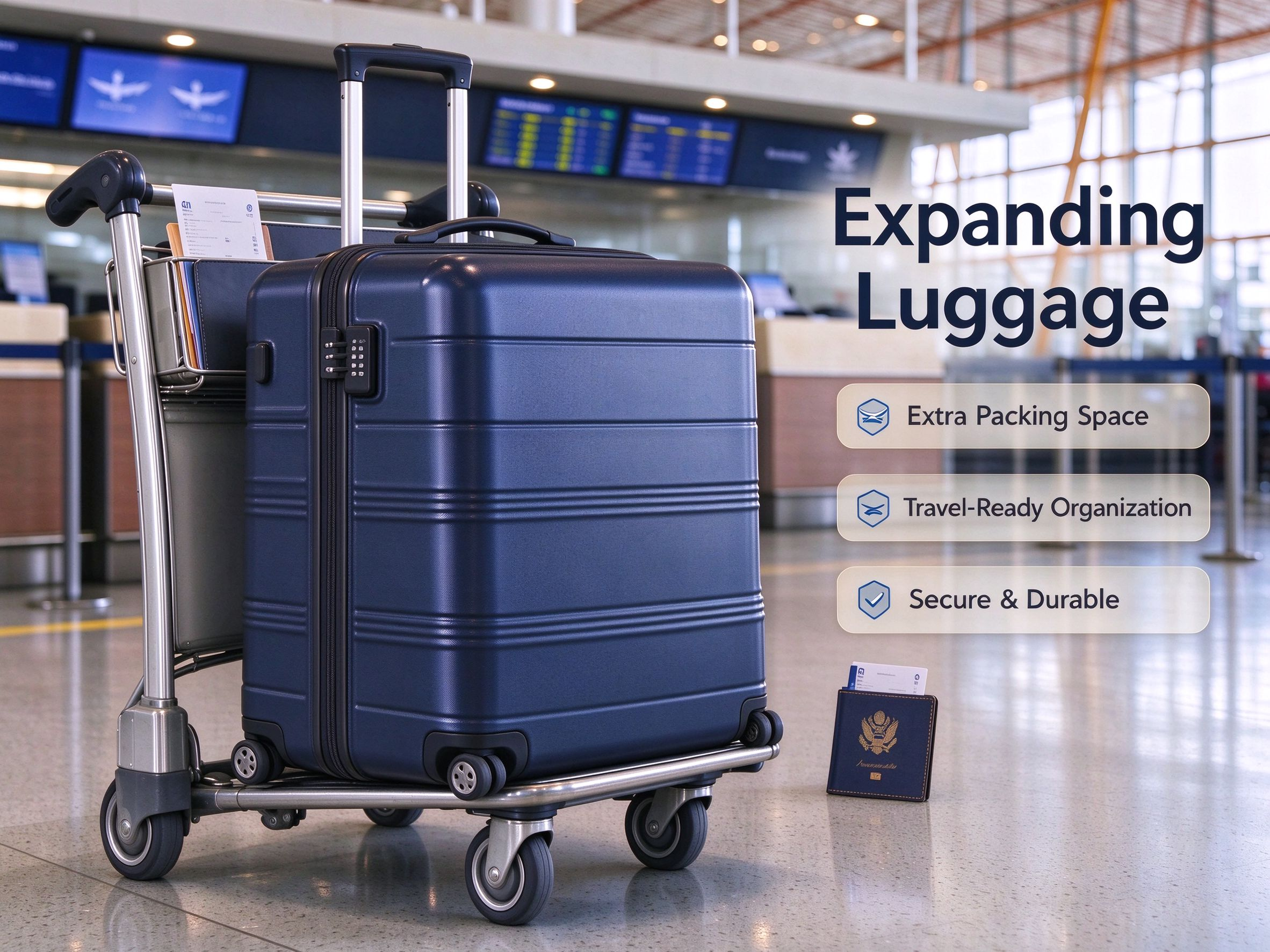
Expandable luggage adds another section that can be opened when more room is needed. In many models, an extra zipper runs around part of the body, and opening it lets the case become deeper.
When that zipper stays closed, the suitcase keeps its compact shape. Open it, and the added section creates more interior volume.
The basic idea looks like this:
Compact setting → lower capacity and slimmer profile
Expanded setting → greater capacity and deeper case
That flexibility is the main reason people choose this type of luggage. They don't need the extra room for every trip, so they can leave the case in its smaller configuration until it becomes useful.
How Does the Expansion Mechanism Create More Packing Space?
Most expandable suitcases gain volume by increasing their depth.
For example, a case might have a body depth of around 24 cm and an expansion section that adds several more centimeters. The actual increase depends on the design.
| Luggage feature | Compact configuration | Expanded configuration |
|---|---|---|
| Case depth | Standard | Increased |
| Internal volume | Lower | Higher |
| Storage flexibility | More limited | More adaptable |
| External footprint | Smaller | Deeper |
| Use case | Departure or light packing | Return trip or additional items |
A few extra centimeters may not sound like much. Across the width and height of a suitcase, though, that added depth can create quite a bit of usable room.
The suitcase doesn't need to become taller or wider. The extra capacity comes mainly from changing one existing dimension.
Does Extra Capacity Mean the Suitcase Has Become a Different Size?
Not exactly.
An expandable case really has two configurations. In the compact position, it keeps its original dimensions. Once expanded, it becomes deeper.
That difference matters when luggage has to meet airline size limits.
A traveler may use the compact setup on the outbound trip and expand the suitcase on the way home. But once expanded, the total outside depth increases, so the packed case needs to be checked against the relevant baggage rules.
For B2B buyers, this needs to be clear in the product specification. Showing only the compact dimensions isn't enough when the expanded size is noticeably larger.
Manufacturers should provide both contracted and expanded measurements so retailers and customers know what they are actually buying.
Why the Extra Space Is Useful During the Return Trip
One of the clearest uses of Expanding Luggage is handling the way packing needs change during a trip.
A traveler may leave home with folded clothes and carefully organized compartments. A few days later, they may have bought gifts, picked up samples, added another jacket, or simply struggled to fit everything back inside.
With a fixed-size suitcase, there isn't much room to adjust. An expandable case gives the traveler another option before they start carrying a separate bag.
It can be useful for:
- Business trips with documents or samples
- Family vacations
- International travel
- Shopping trips
- Longer holidays
- Trips involving souvenirs or gifts
And when that extra capacity isn't needed, the expansion section can stay closed. That's really the appeal of the design.
Expansion Can Be More Useful When Internal Organization Is Good
Extra space is helpful, but more space alone doesn't guarantee better packing.
A suitcase can gain several centimeters of depth and still feel messy if the interior doesn't make good use of that room.
Manufacturers may combine expansion systems with:
- Zippered divider panels
- Compression straps
- Mesh pockets
- Shoe compartments
- Wet-item sections
- Smaller accessory pockets
These features help keep belongings in place, especially when the case is expanded and packed more heavily.
For B2B buyers, the expansion mechanism should therefore be reviewed together with the interior layout. Extra volume is easier to use when the traveler has some control over how things are packed.
How Expansion Zippers Affect Durability
The expansion zipper is a small component, but it carries an important part of the design.
Once the expansion section is opened, the zipper helps hold that extra depth in place. It has to handle repeated opening and closing, and it may also be under pressure from an overfilled suitcase.
Poor zipper construction can lead to:
- Slider failure
- Broken teeth
- Fabric separation
- Difficulty opening or closing
- Misalignment
- Reduced product life
For luggage factories, zipper quality deserves attention during product development and production inspection.
The exact zipper type can vary with the suitcase design, but repeated-cycle testing is useful. A zipper that feels fine on a sample with no load may behave differently after repeated use with a full suitcase.
The Expansion Panel Also Needs to Handle Load
The expandable section is often made from fabric or another flexible material so it can fold down when the suitcase is not expanded.
When opened, that panel needs to maintain its shape and stay securely connected to the main body.
The material affects flexibility, tear resistance, abrasion resistance, appearance, and long-term durability.
OEM buyers should test the panel under realistic conditions. Open and close it repeatedly, pack the suitcase properly, and then check the seams and material. Empty luggage can hide problems that only show up when the case is packed.
This is one of those areas where a sample test can tell you more than a product description.
Does Expanding Luggage Put More Stress on Wheels and Handles?
It can, especially when the traveler uses the extra space to add more belongings.
A heavier expanded suitcase puts additional load on the wheels, wheel housings, telescopic handle, zipper system, and main shell or frame.
Spinner luggage needs particular attention because the four-wheel setup changes how the weight is supported and moved.
Even though the suitcase may keep the same height and width, adding depth can change internal weight distribution. That can affect how it rolls and how much load reaches the lower structure.
Manufacturers should test the complete suitcase when expanded and properly packed, not only the compact version.
Wheel Position Can Affect the Expanded Suitcase
Wheel placement has a direct effect on balance and handling.
Once a suitcase becomes deeper and heavier, its center of gravity can shift. If the wheel layout doesn't account for that, the case may feel less stable or easier to tip.
Product testing can include:
- Rolling stability
- Turning behavior
- Wheel load
- Handle comfort
- Tipping resistance
- Performance on uneven surfaces
This matters even more for large checked luggage, where the expanded case can carry a substantial load.
Hard-Shell and Soft-Side Expandable Luggage Are Not Identical
Expandable luggage is often associated with soft-side designs, but hard-shell cases can also use an expansion mechanism.
Soft-side luggage has a natural advantage here because fabric can flex as the depth changes. It may also offer more external pockets and flexible storage areas.
Hard-shell luggage uses rigid panels, so the expandable section needs more attention at the joining point. The shell, zipper, and flexible section all have to work together without making the case unstable.
| Luggage type | Expansion characteristics | Typical design consideration |
|---|---|---|
| Soft-side | Flexible expansion panel | Fabric durability and zipper strength |
| Hard-shell | Structured shell with expandable section | Joint construction and shell stability |
| Hybrid | Combination of rigid and soft sections | Compatibility between materials |
The right construction depends on the target product, expected weight, styling, manufacturing process, and price position.
How Expansion Affects Airline Baggage Considerations
Airline baggage rules can depend on case dimensions, weight, route, fare type, and the airline itself.
Expandable luggage creates one extra thing to consider because the dimensions aren't the same in both settings.
A suitcase may be within the compact dimensions when the expansion zipper is closed, but once opened, the case becomes deeper.
For travelers, that means measuring the packed suitcase before going to the airport can be a smart step.
For B2B brands, product information should clearly show:
Contracted dimensions
Expanded dimensions
Product weight
Internal or estimated capacity
This makes the product easier for retailers to explain and reduces confusion after purchase.
The extra volume should also be presented realistically. A suitcase can offer additional room, but size and weight limits still apply when baggage rules are involved.
How Much More Space Can an Expandable Suitcase Provide?
There isn't one fixed percentage for every expandable model.
The added capacity depends on the case width, height, original depth, and how much extra depth the expansion section creates.
A simple way to estimate the change is:
Added volume ≈ suitcase width × suitcase height × added depth
It's only an estimate. Real luggage has rounded corners, internal dividers, frame parts, wheel housings, and other structures that take up space.
For B2B comparisons, measured internal capacity in both compact and expanded configurations is more useful than relying only on an advertised expansion percentage.
Expansion Features Can Create Retail Differentiation
From a retail point of view, expandable construction is easy to understand.
A normal suitcase can be compared by size, wheels, material, appearance, and storage layout. An expandable model gives the retailer another practical feature to talk about: flexible capacity.
That can be attractive to travelers who want one case that works for different kinds of trips.
The message is also pretty straightforward:
“Keep it compact when you don't need the extra room. Open it when you do.”
It connects the product feature to a real packing problem, which makes it easier to explain at the point of sale.
What Should B2B Buyers Check Before Sourcing Expanding Luggage?
Buyers should inspect the suitcase in both configurations.
Useful checks include:
- Expanded and contracted dimensions
- Internal capacity
- Expansion zipper quality
- Fabric or panel durability
- Wheel performance under additional load
- Handle stability
- Interior organization
- Empty suitcase weight
- Repeated opening and closing cycles
- Packaging and shipping protection
For private-label products, sample testing is especially useful.
Pack the case with a realistic load. Open and close the expansion system several times. Roll it across different surfaces. Check the zipper, seams, wheels, handle, and body afterward.
That kind of hands-on test can uncover issues that aren't obvious when the suitcase is sitting empty on a factory sample table.
Can Manufacturers Customize Expandable Luggage?
OEM and private-label luggage projects can include many customization options.
Depending on factory capabilities, buyers may request different case dimensions, expansion depths, shell or fabric materials, lining, zipper types, wheel systems, handle structures, interior compartments, colors, logos, and packaging.
Expansion depth deserves special attention because changing it affects more than capacity. It can also change the outside dimensions and the way the luggage handles when loaded.
So increasing the expansion section isn't just a matter of adding a longer panel. The zipper, wheel placement, structural support, and internal layout may need to change too.
Using Expandable Capacity Without Sacrificing Practicality
Expanding Luggage can give travelers more packing space without making the suitcase permanently larger. That's the main advantage: the user gets a compact case when needed and extra capacity when the trip calls for it.
But the expansion feature works only when the rest of the suitcase supports it. The zipper, expansion panel, wheel system, handle, shell or fabric, and interior organization all play a role.
For B2B buyers, it makes sense to compare the compact and expanded versions under real packing conditions. Checking dimensions, usable capacity, durability, and handling before a bulk order can show whether the extra space is genuinely useful in everyday travel.